Forge & Glory
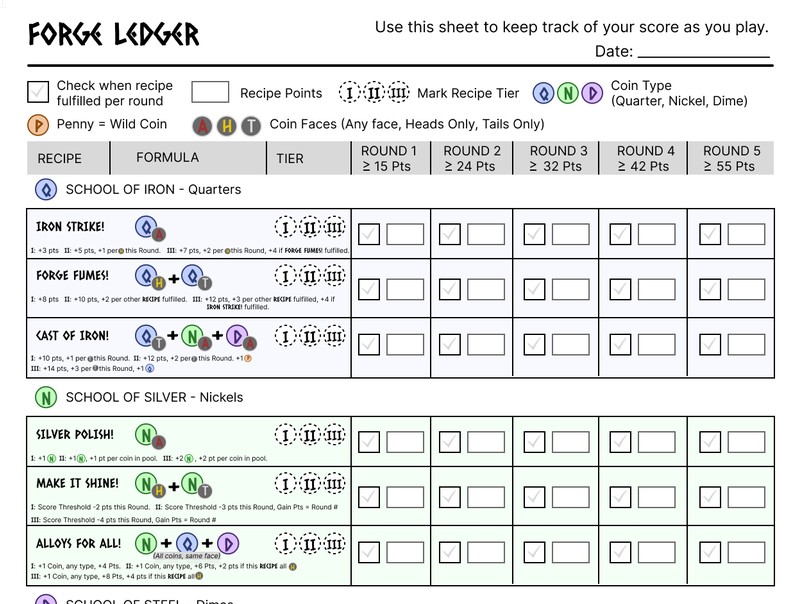
A single-player coin flip-and-write game built inside a tight design challenge: coins, pencil, and paper only, under ten minutes, solo. You're a dwarven smith, and every flip of the hammer is a flip of a coin.
Forge & Glory started as a design challenge: build a game about flipping coins. That’s it. The rest was a box of constraints, and the fun was seeing how much game I could fit inside it.
The Brief
The challenge came with five restrictions:
- The game is about flipping coins.
- Components are coins, pencil, paper, and the rulebook. Nothing else.
- Playtime is under 10 minutes.
- It has to be easy to playtest remotely.
- It’s designed for solo play.
The interesting part is that these constraints fight each other. Solo play removes the tension an opponent usually provides. A sub-10-minute runtime means there’s no room for a slow build. And “flipping coins” is about the lowest-agency action in games: a binary event you don’t control. My entire design goal was to create engaging systems around an otherwise pretty unengaging activity for players.
The Core Loop
You play a dwarven smith over 5 rounds. Each round is the same rhythm:
- Flip your smelting pool of coins (Quarters, Nickels, Dimes).
- Build by assigning coins to Forge Recipes: each recipe wants an exact coin formula (sometimes a specific Heads or Tails face).
- Score your round and compare it to a rising threshold (15 → 24 → 32 → 42 → 55).
- Level up your recipes with the XP you earned.
- Raise the stakes and do it again against a higher bar.
Clear all five thresholds and your total score earns a smithing title:
| Total Score | Title | |
|---|---|---|
| < 50 | Apprentice | Back to the mines with you. |
| 50–100 | Journeyman | Solid work, solid dwarf. You earned a beer! |
| 100–170 | Craftsman | The masters nod in approval. |
| 170–300 | Forgemaster | Songs will be sung of your work. |
| 300+ | Runelord | A legend is born. |
The Design Problem
A coin flip is a single binary event with no player input. If that’s the whole game, there are no decisions, just outcomes. So the design question became: how do you turn “I flipped a coin” into “I made an interesting choice”? Three ideas did the heavy lifting.
Coins as resource and randomizer - The Main Decision Engine
The core insight is that every coin does double duty. The flip is the randomizer, but the coin it produces is then a resource you spend. The player gains agency by deciding where to place their coin - similar to many worker placement mechanics in board games.
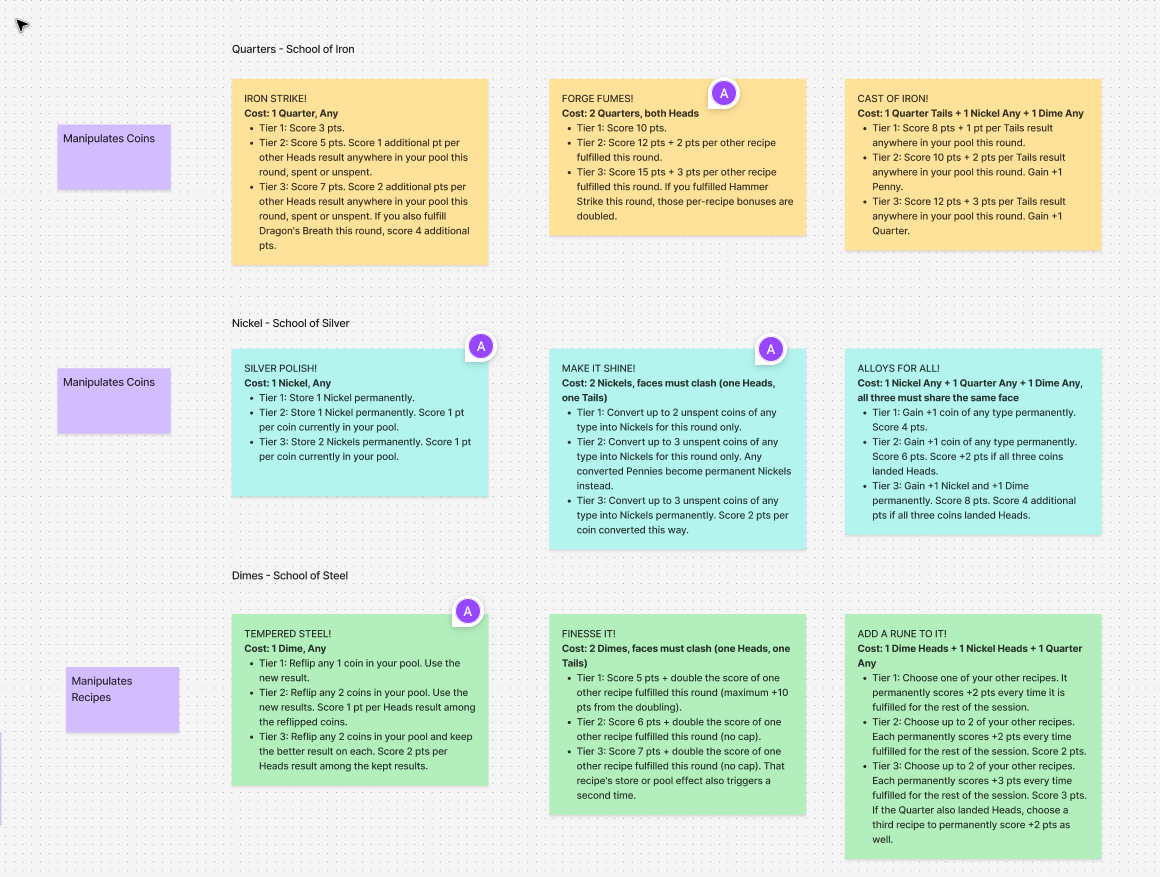
Better still, the coin has two dimensions: its type (Quarter / Nickel / Dime) and its face (Heads / Tails). Forge Recipes built off both: FORGE FUMES! wants one Quarter Heads and one Quarter Tails; ALLOYS FOR ALL! wants three different coins all showing the same face. By using both elements of the coin I gained a new area of depth to help me build the design skeleton around the forge recipes - this is without any added complexity as reading coin types and faces is a low mental tax.
Depth from scarcity - Recipe Synergies and More Decision Engines
You only flip about six coins a round, so every one matters. A few rules turn that scarcity into pressure:
- Unused coins cost you −2 points each, so leaving a coin on the table is a penalty. This incentivizes the player to build optimally and think through their decisions. This feeds into the exact emotional state and player fantasy I wanted.
- Order of fulfillment matters.
FINESSE IT!doubles the score of another recipe fulfilled this round, so you have to sequence your builds to line up the multiplier; the coins are the same, but the order is a decision. The design skeleton for the recipes made use many different axis and mechanics which made the synergies easy for the player to see. - The Penny is a press-your-luck wild coin. It can stand in for any coin type, but you flip it when you deploy it: Heads is clean, Tails costs you −1. One-time use, gone for the game. A small, spicy risk right when you need to rescue a build. A fun push-your-luck decision engine to add variety.
XP - A Progression System
The reward and XP system is where the replayability lives. Every recipe has three tiers, and you spend XP gained from your round score to level up your recipes. That creates a snowball: a strong round funds better recipes, which power a bigger round, which clears a higher bar.
Because it’s solo, that engine has to supply its own tension, so the thresholds escalate every round and the recipes interlock. SILVER POLISH! permanently grows your coin pool; ALLOYS FOR ALL! can enchant another recipe for the rest of the game; TEMPERED STEEL! lets you reflip. The result is that a five-minute solo game still delivers an satisfying arc (small first strikes building to a late-round engine), and no two runs level up the same way. The randomness of a coin becomes the input to a decision engine rather than the whole experience.
Process Breakdown
Ideating
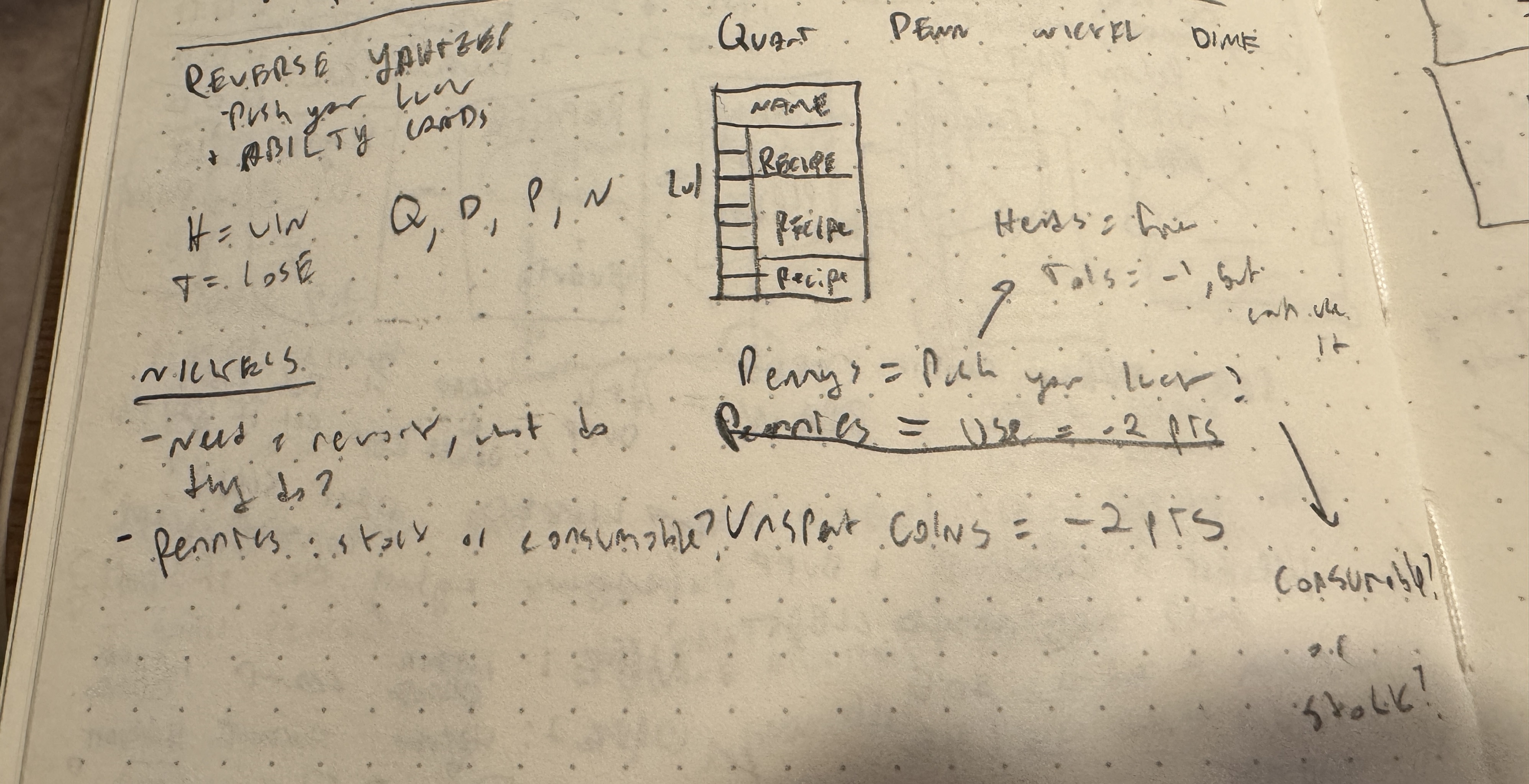
I started by sketching out some ideas for 3 different prototypes I could rapidly test on paper. One that ended up becoming Forge and Glory, one I called “Boxes and Traps”, and finally a Pachinko style roguelite game.
- Boxes and Traps: I prototyped and playtested this out first as I was interested in exploring all the different ways a player could flip a coin - for example: thumb flips, rolls, spins, call outs, flicks, and more. While it was fun - the decision engines and systems weren’t strong enough to continue.
- Forge and Glory started as thinking about the player archetype of an optimizer. Making a game where you had to make optimal decision at every stage to win. I thought of the player fantasy of being a financial day trader - attempting to make the most optimal moves at every moment. The idea of “Coins + Yahtzee” also entered my mind and the theme of a dwarven forge came from another idea in my notes app.
- From there I quickly wrote out a prototype rulebook so I could test the main engine. I didn;t worry about balance or what numbers were “perfect” - I just picked the main US coin faces I had in front of me and quickly sketched what the “Recipes” would look like.
- I knew I needed systems to build around this or it would get boring quick - so naturally a XP and leveling up your recipes made sense so the player could have very clear goals and rewards to keep them going.
- Finally, since I love a good theme, I came up with the idea of rewarding the player with a thematic title upon their final score which aided in replayability as they chase the prestigious “Runelord” title.
I used Figma to design the final rulebook ledger.
Analyzing Games
- I analyzed a lot of different “roll and write” games which are perfect for this kind of design challenge, since they are often solo-play focused and their rulebooks are elegantly designed into their ledgers.
- I mainly studied: Fleet’s Roll and Write Solo Version, Encore!, French Quarter, and more for inspiration and rulebook design.
Playtesting
- I had the game playtested by 7 people.
Post-Mortem
Forge & Glory was submitted as a design challenge as part of a Systems and Progression design course that I took through GameDesignSkills and it received high-praise from my instructors.
However, it did fall short of one of it’s design pillars. The game is nowhere near 10 minutes long. It sits more in the 20-30min range. I beleive I can cut some complexity down by redesigning the ledger to have a less complicated UI/UX which would reduce playtime. Ideally, I could get all the rules right into the ledger itself, especially if I used different paper sizes.