Escape from Area 51!
A cooperative tile-flipping adventure for 1-4 players, Escape from Area 51! combines wacky sci-fi antics with stealthy, strategic chaos as you race to freedom.
Goal and Approach

My goal was to create a game where theme and mechanics are inseparable, where every system reinforces the player fantasy of escaping Area 51, delivering the kind of thematically rich cooperative experiences I love to play.
- Thematic Justification: I aligned player objectives with character motivations so mechanics reinforce the narrative, players don’t just move pieces, they embody trapped aliens fighting for survival.
- Player-Centered Design: I designed for players like myself who value cooperative strategy, creating an action pool system that balances social coordination with individual autonomy.
- Tile-Reveal Tension: Inspired by Sub Terra and Betrayal at House on the Hill, I built mounting tension through map exploration where each revealed tile brings uncertainty and emergent stories.
I sought regular feedback from Jeremiah Franczyk (Lord of the Rings Online), who pushed me to strengthen player motivations and ensure thematic resonance remained central throughout development.
Overview and Technique Highlights
Game Premise: You are aliens from another world, captured and contained deep within the secretive halls of Area 51, but not for long. You and your fellow extraterrestrials have broken free from your containment pods only to discover that meddling scientists have removed critical components from your ship. Now you must sneak, scurry, and zap your way through the facility to recover the missing parts, outsmart human defenses, and make your daring getaway before lockdown traps you forever!
A cooperative tile-flipping adventure for 1-4 players, Escape from Area 51! combines wacky sci-fi antics with stealthy, strategic chaos as you race to freedom.
Technique Highlight 1 — Graduated Suspicion Deck System
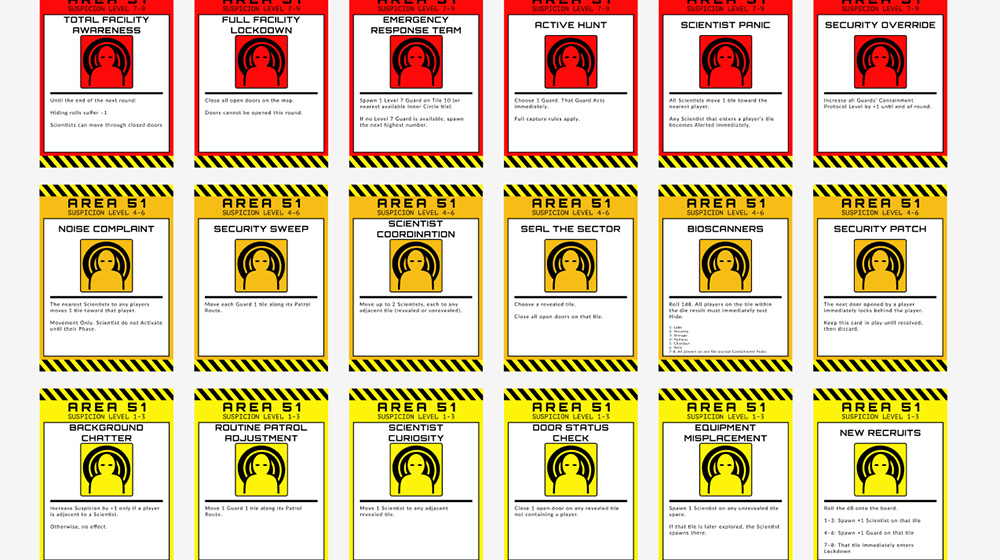
Goal: I wanted tension to escalate organically as players take riskier actions, mirroring how a real facility would respond to an escape attempt.
Result: I created three tiered Suspicion Decks (Yellow, Orange, Red) that increase in severity as the Suspicion Meter rises. (Shoutout Sarah Shipp for the design inspo!)
Techniques
- The suspicion meter acts as both a loss condition timer and a difficulty modifier, making every risk-increasing action (like attacking instead of hiding) feel consequential
- Higher suspicion decks introduce more dangerous facility responses, creating a feedback loop where player aggression breeds escalating threats
- The system is thematically justified because facility awareness naturally intensifies as the escape becomes more obvious, aligning mechanics with narrative
Technique Highlight 2 — Tile-Reveal Map Building
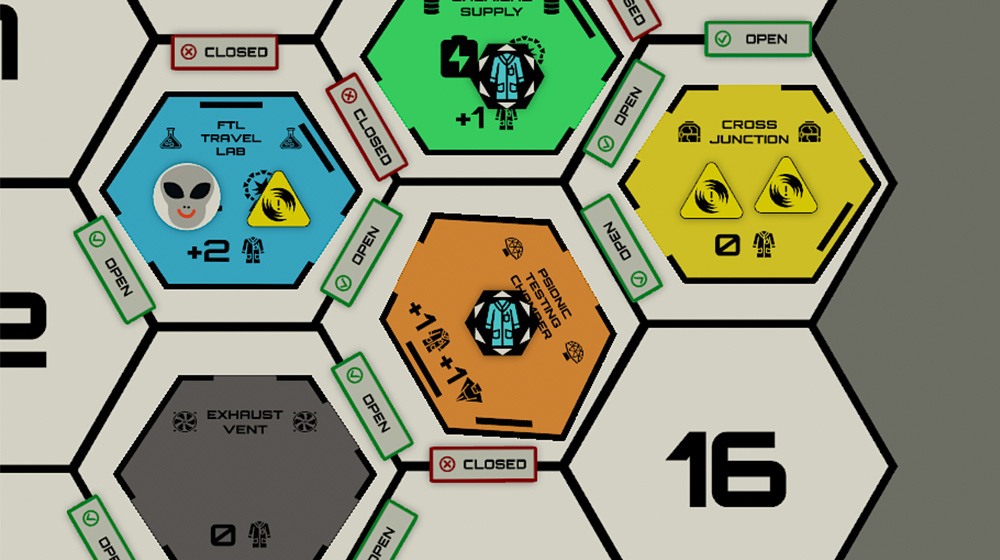
Goal: I wanted exploration to feel tense and unpredictable while staying true to the theme that aliens wouldn’t know Area 51’s layout.
Result: Players draw and place map tiles during exploration, revealing new rooms, enemies, and events dynamically.
Techniques
- Door alignment rules create spatial puzzles where players must find valid placements, slowing progress and building tension organically
- Each tile spawns enemies and potentially triggers events immediately upon placement, ensuring exploration always introduces new threats
- The unknown map layout is thematically justified since the aliens are trapped in a secret facility they’ve never seen before
Technique Highlight 3 — Push-Your-Luck Hide Mechanic
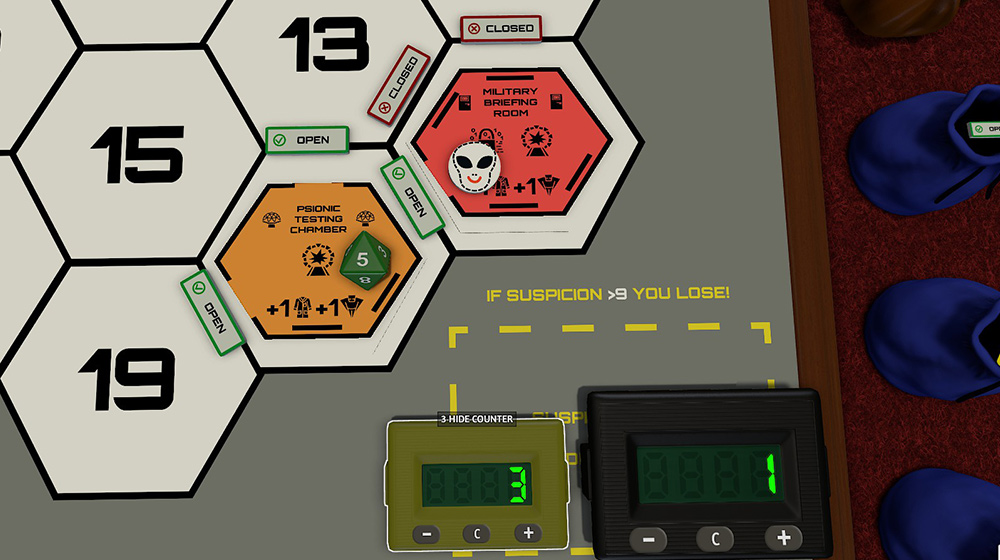
Goal: I wanted players to feel the thrill and risk of hiding from guards while ensuring the mechanic couldn’t be exploited infinitely.
Result: The Hide action uses an escalating Hide Counter that makes repeated hiding increasingly risky.
Techniques
- Rolling 1d8 against an incrementing Hide Counter creates tension where early hides feel safe but later attempts become desperate gambles
- The counter resets only when players are captured or caught in lockdown, forcing players to balance evasion with more aggressive plays
- Auto-failure at 9+ pushes players toward varied strategies rather than hide-spamming, while staying thematic (guards learn your hiding spots)
Process Breakdown
Research, Ideation & Planning
Analyzing Games
- Mechanics (Sub Terra, Forbidden Island, Betrayal at House on the Hill): I drew from tile-reveal map exploration, action pool player agency, randomized event decks for replayability, and countdown timers that create tension through risk/reward decision-making.
- Theme (Destroy All Humans, Portal): I wanted to capture 1950s sci-fi camp and subvert expectations by letting players embody the aliens instead of the humans, creating a fun role-reversal that aids immersion and piggybacking on familiar UFO tropes.
Ideating Mechanics
- Hidden Map Tiles: Like Sub Terra’s cave exploration, aliens wouldn’t know Area 51’s layout, so tile-reveal mechanics create thematic tension and evoke the feeling of sneaking through unknown corridors during a prison break.
- Action Pools: This system grants player autonomy to adapt strategies to the changing game state, letting players embody their escaped extraterrestrial however they see fit.
Resonant Theming
- Area 51 and Extraterrestrials: The setting’s inherent secrecy and mystery pairs perfectly with tile-reveal mechanics since no one actually knows Area 51’s layout, justifying why players build the map as they explore.
Design Document — Rulebook
Premise: You are aliens from another world, captured and contained deep within the secretive halls of Area 51, but not for long. You and your fellow extraterrestrials have broken free from your containment pods only to discover that meddling scientists have removed critical components from your ship. Now you must sneak, scurry, and zap your way through Area 51 to find the missing components, fix your ship, and blast off for home before lockdown traps you forever.
Core Systems:
- Tile-flipping map exploration creates tension and unpredictability with every revealed room
- Graduated Suspicion Deck system escalates facility responses as players take riskier actions
- Action pool with cooperative turn structure grants player autonomy while encouraging coordination
Theme: Players embody escaped extraterrestrials with goals that mirror their own – both want to escape – creating immersion where mechanics reinforce narrative rather than feeling arbitrary. The unknown map layout is thematically justified by Area 51’s clandestine nature, while wacky sci-fi elements permeate the event decks, tile designs, and gameplay moments to deliver humor that helps ease tension in equal measure.
Prototyping
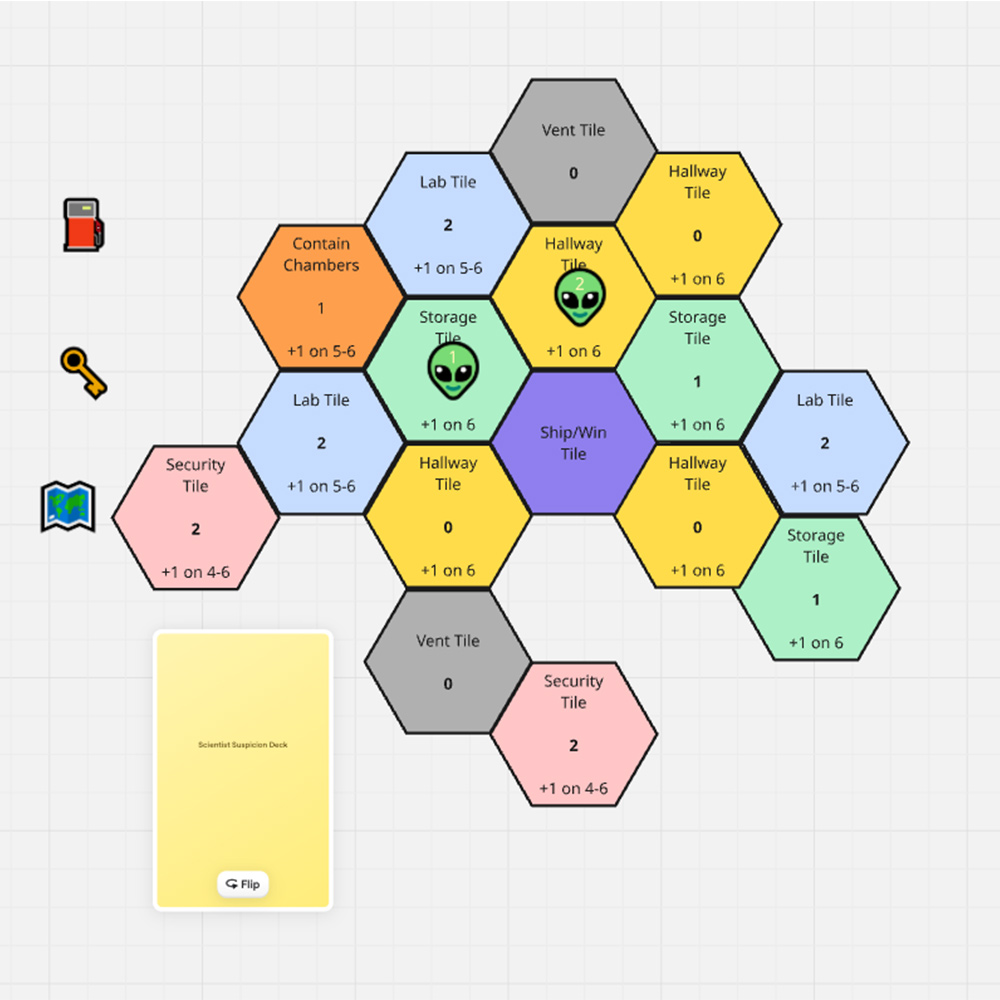
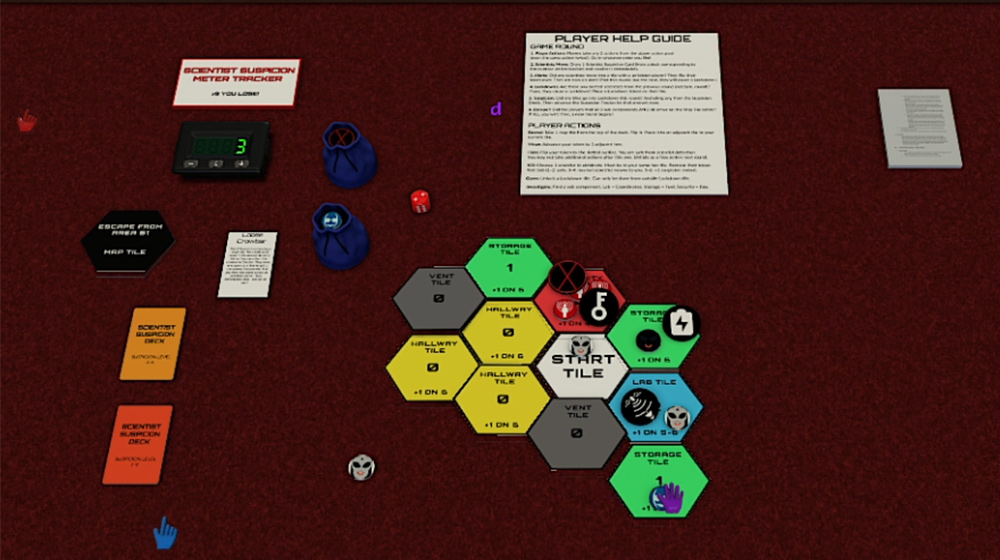
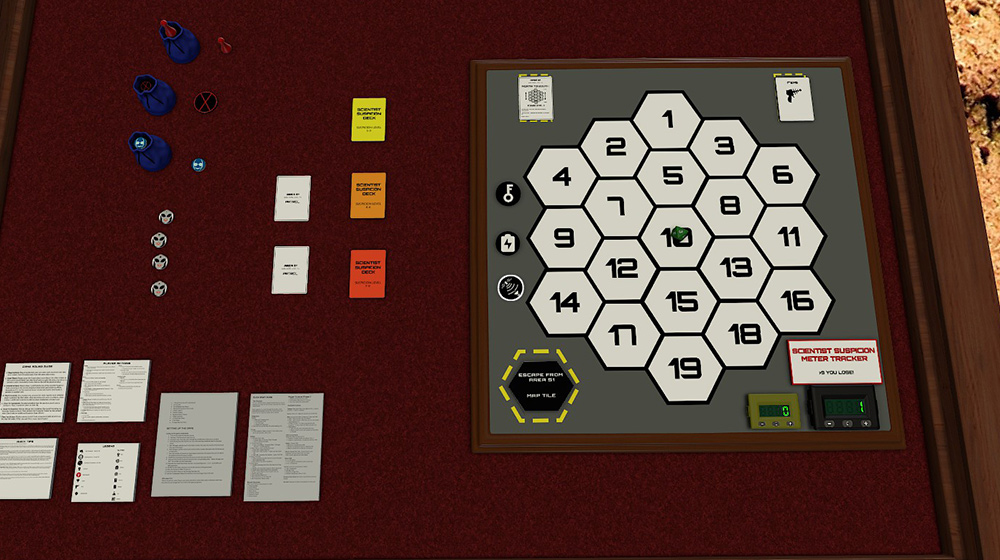
Iteration 1: Event Deck Functionality
Result: The initial event deck created chaos and tension, but many cards had no effect because their mechanics referenced map tiles that hadn’t been placed yet, causing dead draws that stalled gameplay.
Goal: Create an event deck that consistently randomizes the game state and gives players meaningful new challenges each round.
Solution:
- Rewrote all event cards to simplify effects and remove hard dependencies on specific unrevealed tiles
- Added a queue rule allowing players to defer unresolvable event cards until conditions are met
- Ensured every card could create tension regardless of current board state
Iteration 2: Graduated Suspicion System
Result: Event cards were thematically fun but lacked mechanical teeth, they didn’t tie into the game’s core tension or increase difficulty as the escape attempt progressed.
Goal: Align the event system with the game’s loss condition and escalate difficulty to match player risk-taking.
Solution:
- Split the single event deck into three tiered Suspicion Decks (Yellow, Orange, Red) inspired by Sarah Schipp’s graduated deck design
- Tied each deck directly to the Suspicion Meter so riskier player actions (attacking vs. hiding) trigger increasingly severe facility responses
- Expanded from 12 total cards to 18 (three sets of 6) to provide variety within each difficulty tier
Iteration 3: Component-Based Victory Condition
Result: Players won too easily by simply reaching the ship tile, and many interesting tile types (Labs, Security, Storage) were being ignored during gameplay.
Goal: Increase difficulty and player-enemy interactions while incentivizing exploration of all tile types.
Solution:
- Implemented a three-component system (Fuel, Coordinates, Override Codes) that players must collect before escaping
- Placed components on high-risk tiles with elevated enemy spawn rates (Labs, Security, Storage) to force confrontation
- Required players to backtrack and engage with the map strategically rather than beeline to the ship
The First Interactable
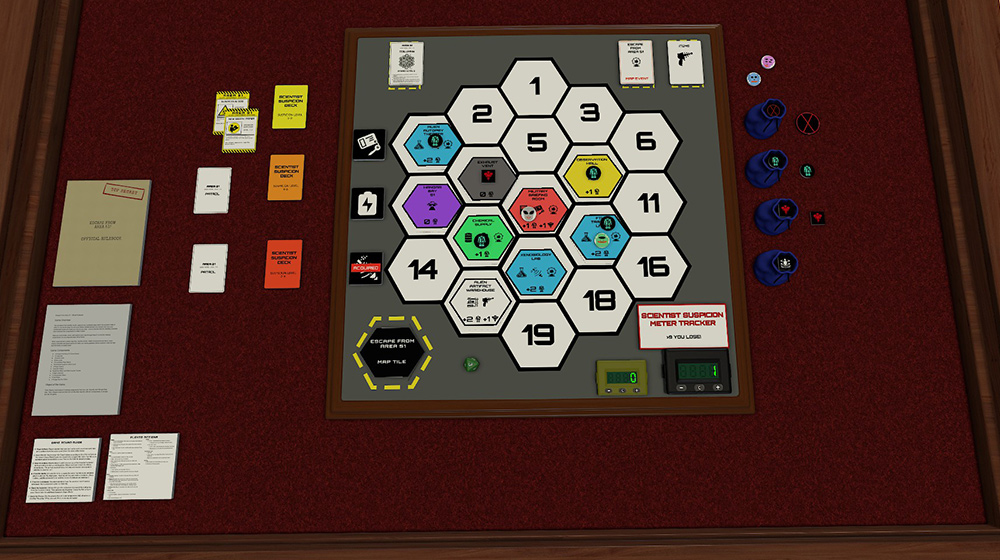
This playable prototype was the most successful and closest to the final design.
Result: The playable prototype successfully blended strategic cooperation with thematic justification, creating a tension-building escape experience where the graduated event deck and randomized tile placement ensure something new to react to every round.
Goal: Build a fully functional prototype in Tabletop Simulator to test all core mechanics with custom-designed components including event decks, enemy tokens, player tokens, and map tiles.
Implementation:
- Mechanic Synergy 1 (Tile Exploration): Players must locate specific tiles to find victory components, creating tension with each reveal since they don’t know what they’ll draw. This randomizes enemy spawns and obstacles while staying thematically true to aliens sneaking through an unknown facility, reinforcing the fantasy of peering around corners into unexplored rooms.
- Mechanic Synergy 2 (Graduated Suspicion System): The tiered Suspicion Decks escalate alongside the Suspicion Meter (the game’s loss condition), forcing players into a strategic bind where they must take risks that increase suspicion to progress, knowing each level brings more dangerous facility responses.
- Narrative Synergy (Thematic Resonance): Event card descriptions and tile names (Containment Pods, Alien Artifact Warehouse, Security) immerse players in wacky sci-fi camp, making mechanical moments feel like story beats rather than abstract game actions.
Playtest and Key Iterations
Playtest Highlight 1: Hide Mechanic Balance
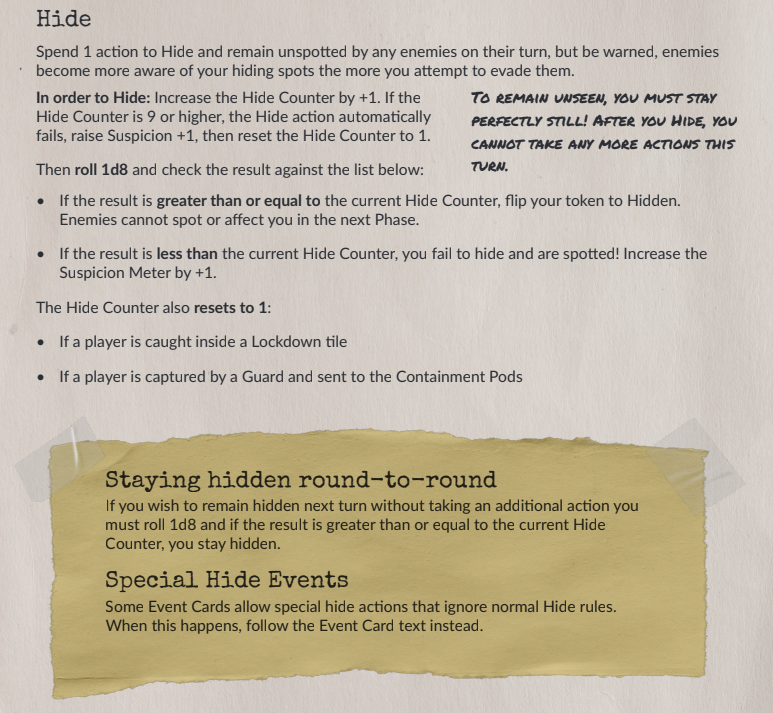
Result: Initial playtests revealed that the Hide action was simultaneously overpowered and underutilized, players could spam it to avoid all threats, making the game too easy, but they often ignored it in favor of more aggressive plays that felt intuitively more exciting.
Feedback and Problem: Players reported that “hiding is too overpowered” and found it “unsatisfying” compared to attacking, which offered push-your-luck excitement. One tester suggested “hide should be like a wild magic surge, first hide is free but then it gets harder and harder,” while others noted they couldn’t plan strategically because hiding removed all risk.
Solution: Implemented an escalating Hide Counter system where each successive hide attempt becomes riskier (roll 1d8 vs. increasing counter), auto-fails at 9+, and resets only when players are captured or caught in lockdown. This preserves the thematic tension of “guards learning your hiding spots” while forcing players to diversify their strategies and making hide a tactical choice rather than a dominant strategy.
Playtest Highlight 2: Scientist Movement Clarity
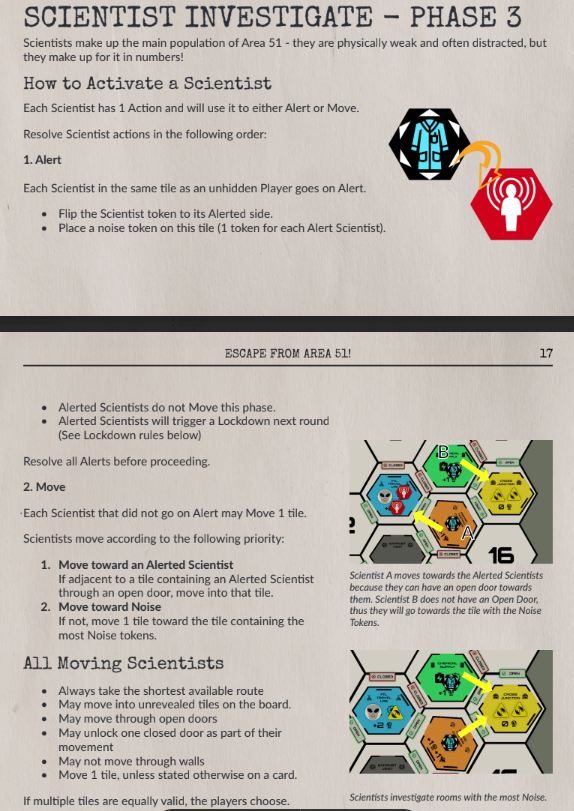
Result: Players consistently misunderstood scientist movement rules, leading to incorrect gameplay where scientists teleported across the map, moved while alerted, or had unclear targets when multiple options existed.
Feedback and Problem: Testers reported confusion about “where the scientists move” and “who the nearest player was” on event cards, with one player moving an alerted scientist two tiles away when the rules stated alerted scientists can’t move. Another noted “they didn’t understand that the scientists were the enemies” and frequently made up their own movement rules when equidistant options existed.
Solution: Added Noise Tokens as a result of certain player actions. Then, rewrote scientist movement priority system with clear numbered steps (Alert > Move toward Alerted Scientists > Move toward Noise), added visual examples to the rulebook showing movement resolution, and created a player-choice rule for equidistant movement scenarios.
Playtest Highlight 3: Setup and Tile Placement Confusion
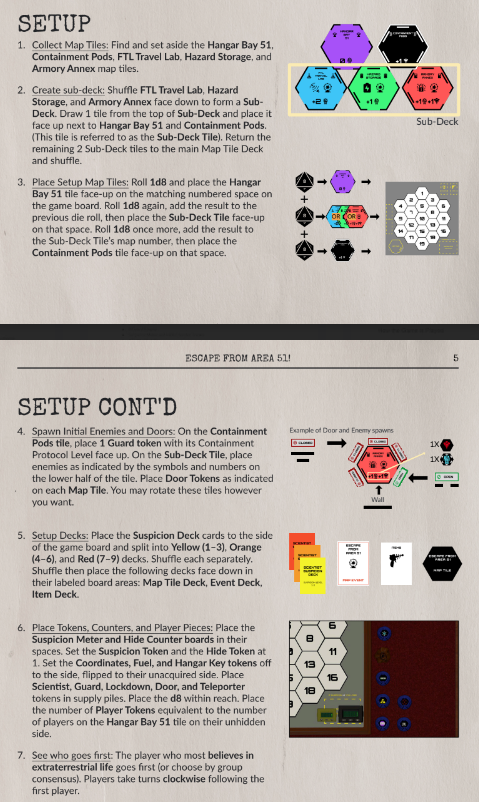
Result: Setup procedures and tile placement rules were major pain points across all playtests, with players struggling to understand door alignment, enemy spawns, and the explore vs. move distinction, causing frustration before gameplay even began.
Feedback and Problem: Players reported the setup was “really confusing,” didn’t understand “do we flip before we place the tiles?”, and one player “moved to an adjacent tile that had no tile on it” because they confused explore and move actions. The spawn modifier step during setup required verbal explanation.
Solution: Redesigned rulebook with visual step-by-step setup instructions showing exact tiles to pull, and clarified that explore means “draw, place aligned to open doors, THEN move into new tile.” Also, added visual diagrams for door alignment rules and enemy spawn icons.
Polished Portfolio Piece
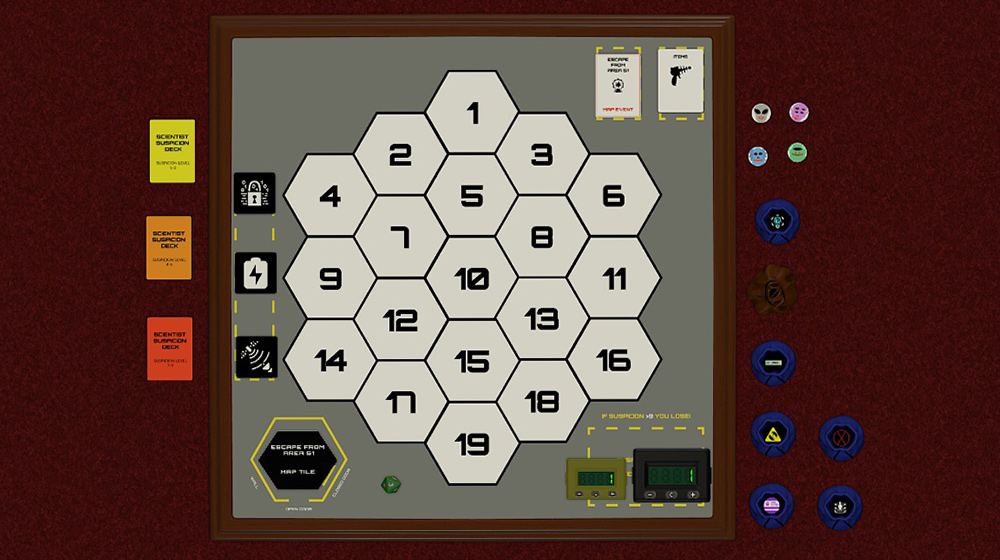
Result: Escape from Area 51! is a fully realized tabletop game with a complete 20-page rulebook, 19 custom map tiles, 18 Suspicion Deck cards across three difficulty tiers, 19 Map Event cards, 9 Item cards, and all necessary tokens and player materials ready for manufacture and playtesting.
Goal: Deliver a thematically rich cooperative experience where players feel genuine tension sneaking through Area 51, making meaningful strategic decisions under pressure, and experiencing emergent stories through randomized map exploration and escalating facility responses.
Execution:
- Thematic Mechanical Integration: Every system reinforces the escape fantasy, tile-reveal mirrors exploring unknown corridors, the graduated Suspicion Deck represents escalating facility awareness, and the push-your-luck Hide mechanic creates the tension of avoiding detection in a place you shouldn’t be.
- Strategic Depth Through Synergy: The component-based victory condition forces players into high-risk tiles, the action pool enables flexible cooperation, and the Suspicion Meter creates a strategic tension where aggressive plays speed up progress but trigger more dangerous responses.
- Replayability and Emergence: Randomized map layouts, three tiered event decks, varied enemy patrol patterns, and dynamic door placements ensure no two games play the same, while thematic event cards and tile types deliver sci-fi camp moments that turn mechanical choices into memorable narrative beats.