Skeletom
A skeleton running for mayor of a very strange town. Drag-and-drop vignette puzzles with tiered vote rewards — how well you help people, not just whether you do, determines if democracy prevails.
Overview
Skeletom is a skeleton who has decided, for reasons that are probably fine, to run for mayor of his small, strange town. The current mayor is a satanic figure of vague but clearly evil intent who has held power for too long. To win, Skeletom must earn votes by solving townsfolk problems across three locations — and how well he solves them, not just whether he does, determines the outcome.
The game is a fixed-viewport puzzle adventure built around drag-and-drop vignettes. Each location contains a self-contained scene with a problem and a tiered solution system: the more elegant the solve, the more votes earned. Win enough votes, the mayor falls. Democracy prevails. Skeletons rule.
Tone: Twin Peaks meets Richard Scarry’s Busytown. Gravity Falls meets Thank Goodness You’re Here. Weird, warm, wacky — in that order.
My Role
Producer and game designer on a team of three. With a team this small, roles blur — but my core responsibilities are:
- Producing — Running all meetings, setting up project management in Milanote and Discord, assigning tasks, and keeping the project moving forward
- Game Design — Wrote the Game Design Document and Puzzle Design Primer; defined the core mechanics, tiered vote reward system, and the six puzzle patterns the vignettes are built from
- Narrative — Drafted initial story beats and worked with the narrative designer to develop a more polished version
- Art Direction — Reviewing concepts and giving directional feedback as the visual language develops
The Design Work
The central design challenge: how do you build a puzzle system with meaningful depth inside a very short play session?
Most narrative puzzle games are binary — you get it right or you don’t. That’s fine, but it flattens the experience for players motivated by discovery and completion. The tiered VP system was designed to solve that.
Each vignette has four possible outcomes:
- Tier 1 — Wrong: The player drops the entirely wrong item. The NPC reacts with confusion or mild offense. 0 VP. Comedic, not punishing.
- Tier 2 — Fine: The obvious item. It works. The problem is technically solved, but the solution lacks care. Low VP.
- Tier 3 — Good: The player noticed something extra — a second item, the right order, a detail hidden in the NPC’s dialogue. Mid VP.
- Tier 4 — Perfect: The specific combination the scene was designed around. Usually involves one extra step — the “almost right” item transformed into the correct state before use. Full vote reward + fanfare sting.
With 3 vignettes at 3 VP max each, the total possible score is 9 VP. The mayor’s threshold produces three distinct endings: defeat, narrow win, and landslide — each with its own story resolution. The narrow win tier is deliberately designed to leave cracks: which problems were half-solved? What does a town look like when it’s only somewhat better? It’s the tier that makes a second playthrough feel worthwhile.
The design prompt I apply to every vignette: What is the “almost right” item, and what one additional step transforms it into the perfect answer?
Status
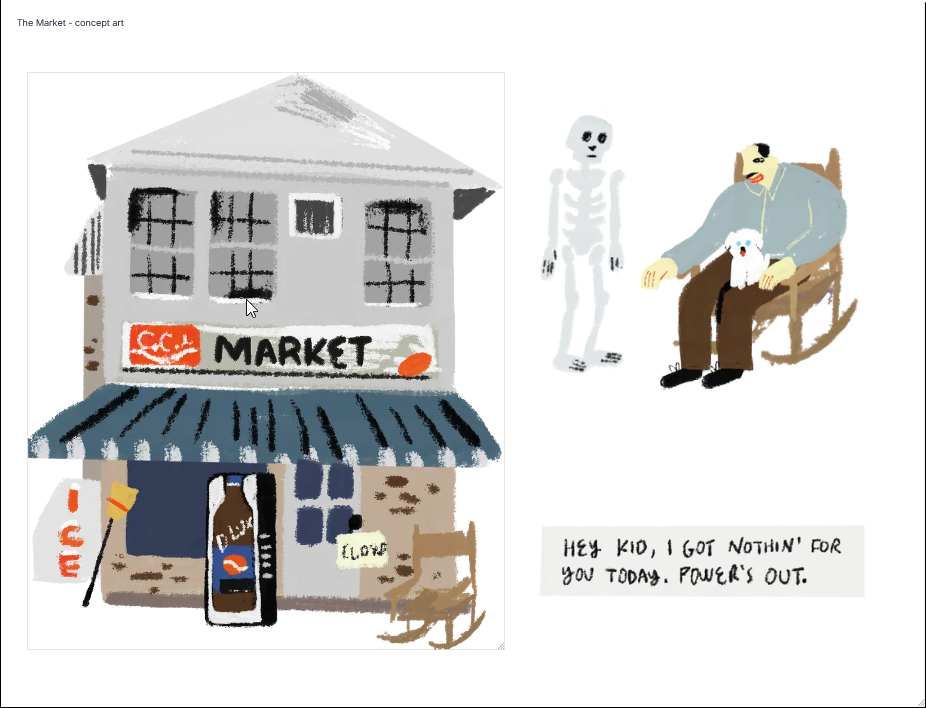
Early development. The GDD and Puzzle Design Primer are complete. The narrative designer is developing character and story beats. The artist is in early concepting — the Market scene above is the first environment out the door. First playable vignette is the next milestone.